
NCCID Disease Debriefs provide Canadian public health practitioners and clinicians with up-to-date reviews of essential information on prominent infectious diseases for Canadian public health practice. While not a formal literature review, information is gathered from key sources including the Public Health Agency of Canada (PHAC), the World Health Organization (WHO) and peer-reviewed literature.
This disease debrief was prepared by William To-Dang. Questions, comments, and suggestions regarding this debrief are most welcome and can be sent to nccid@umanitoba.ca.
What are Disease Debriefs? To find out more about how information is collected, see our page dedicated to the Disease Debriefs.
Questions Addressed in this debrief:
- What are important characteristics of impetigo?
- What is happening with current outbreaks of impetigo?
- What is the current risk for Canadians from impetigo?
- What measures should be taken for a suspected impetigo case or contact?
What are important characteristics of impetigo?
Cause
Impetigo is a mild, but highly contagious skin infection caused by bacteria that normally reside on the body. The infection can be caused by gram-positive Staphylococcus aureus, Group A beta-haemolytic Streptococcus bacteria (e.g. Streptococcus pyogenes) or a combination of the two, with both types intermittently colonizing nasal, pharyngeal, perineal and axillary areas. These bacteria may cause impetigo as a primary infection through colonisation of healthy skin, or as a secondary infection through colonisation of injured skin (e.g. cold sores, insect bites, patches of eczema and scrapes).
Impetigo frequently appears in hot, humid summer weather. In tropical climates Group A Streptococcus bacteria are the main pathogenic bacteria, and in temperate climates S. aureus is the dominant pathogen. Impetigo spreads quickly either by person-to-person contact when an infected individual touches their blisters or rash and then touches another individual, or when a healthy individual touches objects or surfaces that have already come into contact with the rash of an infected individual (fomites).
Impetigo A-Z Disease Fact Sheets — Government of New Brunswick
Impetigo Information Sheet — York Region Community and Health Services Department
Signs and Symptoms
Generally, affected individuals present with a skin rash resembling red bumps, which appears 1 to10 days after an individual has become infected. Impetigo has three different forms: non-bullous impetigo (associated with both S. aureus and S. pyogenes), bullous impetigo (associated specifically with S. aureus), and ecthyma. All forms can affect general wellbeing and daily living with pain, itching, discomfort, and possible sleep disturbance.
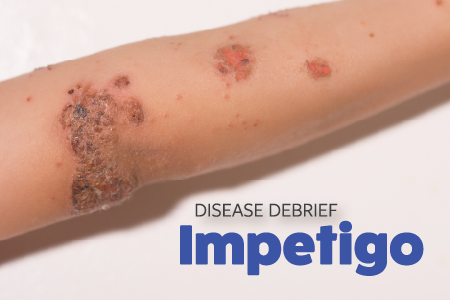
Non-bullous impetigo is considered to be the most common form of impetigo, accounting for 70% of cases. It is characterized by clustered erythematous vesicles or pustules that quickly evolve and burst, with exudate from the lesion base forming gold-coloured crusts typically seen on the extremities and face. Smaller lesions may coalesce into larger-crusted plaques.
Bullous impetigo is characterized by painless and flaccid fluid-filled blisters (that derive from exfoliative toxins created by S. aureus species) on the arms, legs and trunks that are less readily rupturable into thin brown crusts. Blisters that do burst within 24 hours will scab over with a yellow-coloured crust. The skin around the blisters is often red but not sore.
Ecthyma is a more serious form of impetigo with infection entering deeper into the dermis. Signs and symptoms entail painful fluid- or pus-filled sores that evolve into deep ulcers surrounding erythema on the legs and feet. Hard, thick, gray-yellow crust may cover the sores and lymph glands may be swollen in the affected areas. Little holes, that range from the size of pinheads to pennies, may appear after the crust degrades and scars may remain even after the ulcers heal.
With pruritus being common in all 3 forms of impetigo, scratching can spread infection, inoculating adjacent and nonadjacent skin.
Impetigo A-Z Disease Fact Sheets — Government of New Brunswick
Impetigo Information Sheet — York Region Community and Health Services Department
Impetigo and Ecthyma — Merck Manuals
Impetigo and scabies — Disease burden and modern treatment strategies — Yeoh et al., 2016
Severity and Complications
Impetigo takes at least 2 to 3 weeks to clear, but antibiotics reduce the time it takes to heal. If impetigo is left untreated, the rash can spread around the nose, mouth and rest of the face and can also appear on parts of the skin not covered by clothes, such as the arms and legs.
Severe cases of impetigo may induce:
- Worsening redness
- Muscle Weakness
- Fever
- Lymph gland swelling in the neck or face
- Severe pain
Impetigo is often found complicating scabies, and can cause abscesses, sepsis and invasive infections with S. aureus and S. pyogenes bacteria. Scabies-infected children are 12x more likely to develop impetigo compared to those with healthy skin. While the following are rare, immunological-related complications of impetigo include:
- Bacteremia
- Erysipelas
- Cellulitis
- Osteomyelitis
- Septic arthritis
- Lymphangitis
- Lymphadenitis
- Guttate psoriasis
- Staphylococcal scalded skin syndrome
- Streptococcal toxic shock syndrome
- Acute rheumatic fever
- Acute poststreptococcal glomerulonephritis
- Rheumatic heart disease
- Chronic kidney disease
Worth noting is that the underdeveloped immune systems of newborns make them the ones most at risk for serious complications (e.g. tissue or blood infections around the brain with meningitis).
Impetigo A-Z Disease Fact Sheets — Government of New Brunswick
(Health Topics) Scabies — World Health Organization
Impetigo: Diagnosis and Treatment — Hartman-Adams et al., 2014
Impetigo and scabies — Disease burden and modern treatment strategies — Yeoh et al., 2016
Epidemiology
Impetigo occurs globally and affects people of all ages, with children being most affected. Approximately 162 million children (particularly those aged 2-5 years) are affected by impetigo around the world: over 2% of the global population. Impetigo is one of 8 dermatologic conditions listed in the 50 most common causes of disease in the Global Burden of Disease study and is one of the few skin conditions with potentially life-threatening complications.
While in developed and industrialized settings complications from impetigo are rare, in resource-poor settings and marginalized communities the impact is more severe. The burden of impetigo increases as socioeconomic status decreases because the contagious nature of impetigo is amplified by poor hygiene practices and inadequate housing. Recent global estimates of impetigo include 111 million children from developing countries being affected. Impetigo is endemic in several low-and-middle-income tropical countries, but the highest burden is observed in underprivileged children from marginalized communities in high-income countries.
Epidemiological data on impetigo is incomplete and likely underestimates true disease burden. Most available statistics derive from hospital records, which may underrepresent true population prevalence of impetigo. The true prevalence of impetigo may be underestimated, possibly because impetigo in developed countries can commonly occur outside hospital settings, it is manageable without the need to go to a hospital and therefore cases may not be officially recorded. Furthermore, cases that are reported in hospital may be representative of the more severe forms of impetigo. In resource-poor settings underestimation may be linked to reduced likelihood of seeking or obtaining care for skin diseases. Other estimates of impetigo prevalence are imprecise due to the scarcity of published literature from high prevalence contexts. Population-based statistics relating to impetigo in Canada are difficult to find and population-based prevalence studies from Europe and more up-to-date information from North America, East and Southeast Asia are underrepresented.
Impetigo A-Z Disease Fact Sheets — Government of New Brunswick
Impetigo and scabies — Disease burden and modern treatment strategies — Yeoh et al., 2016
Laboratory Diagnosis
Impetigo is diagnosed clinically and it is believed clinical algorithms (e.g. the World Health Organization’s Integrated Management of Childhood Illness (IMCI) skin algorithm) can help pinpoint and treat impetigo, especially in resource-limited areas. Diagnosis of impetigo can be based on the appearance of sores, supported by testing the fluid of sores for bacteria. Furthermore, flip charts with high quality photographs coupled with clinical descriptions are used to by healthcare workers for diagnosing impetigo.
Culturing impetigo lesions (specifically pus or bullous fluid), is typically only indicated when:
- The patient does not respond to empiric therapy
- The patient has recurrent impetigo and needs a nasal culture to identify a potential nasal reservoir
- Persistent infections indicate the need to test for methicillin-resistant S. aureus (MRSA)
Impetigo and scabies — Disease burden and modern treatment strategies — Yeoh et al., 2016
Impetigo and Ecthyma — Merck Manuals
Impetigo: Diagnosis and Treatment — Hartman-Adams et al., 2014
Transmission
Impetigo is very infectious, easily spreading from person to person through nasal discharge or direct contact. If a patient touches their rash and then touches another individual (ie. skin-to-skin contact), the infection can be transmitted. Alternatively, impetigo may spread by fomites, when individuals touch surfaces and objects (e.g., towels or clothing that contact the skin rash, or discharges of lesions, of an infected individual) contaminated with bacteria. It takes 1-10 days for a rash to appear after being infected.
Transmission is most likely in congregate settings of young children (e.g. schools, childcare). Infection can spread rapidly among parents and other contacts of infected children (e.g. siblings and playmates). Impetigo can be spread as long as lesions continue to drain, and up until 24 hours after antibiotic treatment has started.
Other factors that foster impetigo transmission in endemic areas include hot and humid climates, poor water access, and overcrowding. Autoinoculation is also common via fingers, towels, and clothing, leading to the development of satellite lesions in adjacent areas. While impetigo is a self-limited infection, antibiotics can be initiated for a quicker cure and to reduce spread to others.
Impetigo Fact Sheet — Hastings Prince Edward Public Health
Impetigo A-Z Disease Fact Sheets — Government of New Brunswick
Impetigo: Diagnosis and Treatment — Hartman-Adams et al., 2014
Prevention and Control
Besides limiting close contact with infected individuals, a universal prevention and control initiative for impetigo is practicing good personal hygiene. Handwashing is important as impetigo spreads easily through hand-to-hand contact.
Impetigo can be controlled by going to a healthcare provider for diagnosis and following prescribed treatment. It is essential for patients with active infection to minimize contact with others, particularly avoiding contact with newborn babies. Antibiotics help reduce bacterial spread and can allow the typical course of 3 weeks for recovery to be reduced to 1-2 weeks. Patients should stay at home away from their usual institutional, work or daycare setting for at least 24 hours after taking antibiotics or until sores have formed a crust to help prevent spread of infection.
Infected patients should:
- Take baths or showers frequently
- Avoid preparing or handling food (until antibiotics have been used for at least 24 hours)
- Keep infected areas clean by washing with soap and water, covering the areas with bandage or loose gauze afterwards if necessary (i.e. if blisters have not crusted over)
- Not directly pick at or touch sores to reduce chances of autoinoculation and transmission
- Keep fingernails short and clean, with hands being carefully and routinely washed, such as before eating, after leisurely activities, after using the bathroom, and after handling infected areas or articles soiled with discharges from lesions
- If leaving home, sores must still be covered such as with gauze and tape
- As the disease develops, the crusts on skin that form and become loose can be soaked for 15-20 minutes with a warm, wet facecloth, gently washed away with soap and water, then patted dry
Those sharing a household with a person with impetigo should:
- Ensure personal belongings (e.g. bedding, clothes, face cloths, towels, brushes, combs and other personal items) are not shared with others
- Wash the clothes and bedlinens of the infected person separately from the others at home, utilizing hot water for washing and a hot dryer for drying
- Practice good environmental management by thoroughly cleaning, then disinfecting (with chlorine-based disinfectant), objects (e.g. toys belonging to children) and surfaces (e.g. door handles, countertops) that are commonly touched
- Washing hands meticulously and frequently, especially after any physical contact is made with the infected person
Impetigo Fact Sheet — Hastings Prince Edward Public Health
Impetigo Information Sheet — York Region Community and Health Services Department
Impetigo A-Z Disease Fact Sheets — Government of New Brunswick
Vaccination
There is no vaccine to prevent impetigo. Prevention of impetigo is centred around hand-washing and non-infected members in a household shared with an infected individual paying attention to injured or infected skin areas to be kept clean and covered.
Impetigo Information Sheet — York Region Community and Health Services Department
Treatment
Antibiotics are recommended for faster symptom resolution of impetigo, and to stop the spread of disease from person to person. For uncomplicated impetigo, or impetigo with less than 5 lesions on the body, topical antibiotics are most effective, including:
- mupirocin (3 times a day for 1 week)
- fusidic acid (3 times a day for 7-12 days)
- retapamulin (2 times a day for 5 days).
If impetigo is more extensive, having 5 or more lesions or being classified as ecthyma, oral antibiotics such as dicloxacillin or cephalexin (250-500 mg 4 times a day, or 12.5mg/kg 4 times a day for children, for 10 days) are indicated. Treatment should continue for the full duration even if the rash resolves prior to the end of the treatment course.
Keeping sores clean with mild soap and antiseptic lotion is helpful, as are lotions and creams that contain iodine and antibiotics. Treatment may also be required for individuals that are in close contact with infected patients, even if there are no signs or symptoms, as they may be carriers.
Extra Considerations Regarding Treatment
To restore a normal cutaneous barrier in a patient with underlying atopic dermatitis or extensive xerosis within the setting of impetigo, topical emollients and corticosteroids are recommended. For patients who are allergic to penicillin, clindamycin (300 mg every 6 hours) or erythromycin (250 mg every 6 hours) may be used.
There are situations where topical antibiotics for impetigo may not be optimal for patients, including in cases of skin sensitization, local allergic reactions, and challenges applying the antibiotics around the mouth, back and eyelid areas. Some other key considerations would be poor clinical response to oral antibiotics, where overusing specific topical antibiotics may lead increase to antimicrobial resistance and rapid emergence of multidrug-resistant bacterial strains. S. aureus of impetigo can develop resistance to fusidic acid and there is emerging resistance to mupirocin specifically among MRSAisolates, with 24-65% high level resistance to mupirocin being noted in Canada, the United States of America, Australia, Trinidad, Tobago and New Zealand. The World Health Organization has recently noted MRSA as being one of the “priority pathogens” posing significant risk to human health and this resistance should be considered when determining which, or if, antibiotics should be used as treatment. If antibiotics prove ineffective, resorting to instead using soap, lotions and creams containing iodine to keep the sores clean may prove more beneficial.
Impetigo and scabies — Disease burden and modern treatment strategies — Yeoh et al., 2016
Impetigo and Ecthyma — Merck Manuals
Impetigo: Diagnosis and Treatment — Hartman-Adams et al., 2014
Impetigo A-Z Disease Fact Sheets — Government of New Brunswick
What is happening with current outbreaks of impetigo?
Netherlands
A community outbreak of impetigo occurred sometime between June 2018 and January 2020 in the Eastern Netherlands with an epidemiological link to 3 cases from the North-Western Netherlands. The outbreak consisted of 57 cases, including 8 carriers, that were identified with infection or colonisation with MRSA-based impetigo, with 47 being children and the remaining 10 being adults aged between 28-48 years. This outbreak was believed to have been caused from close proximity in crowded settings including with visiting school, family and friends. While most cases were not admitted to hospital — consisting of typical face and extremity-based lesions —1 impetigo case was severe enough to demand hospital admission, being diagnosed with generalized bullous impetigo. The involved cases involved a strain that was resistant to beta-lactam antibiotics, fusidic acid, erythromycin, clindamycin and co-trimoxazole.
The outbreak is notable due to highlighting the risk of antibiotic-resistant strains even in countries such as the Netherlands which have historically low prevalence of antimicrobial resistance. There needs to be more rigorous MRSA surveillance and further collaboration between multiple disciplines to aid early recognition and control of community-onset MRSA outbreaks.
Spain
There was a noted outbreak of at least 48 cases between June 2023 and September 2023 coupled with empirical treatment failure. This led to a review of the associated microbiology results and official outbreak investigation by the public health authorities. Of the 48 cases: 7 experienced recurrence 1 month following resolution of the initial episode and 2 needed hospital admission (1 due to extensive lesions refractory to treatment and the other due to eczema herpecticum). 43.6% of cases had generalized lesions while 47.4% had localized lesions (breaking down into: 27.3% on the face; 9.1% on lower extremities; 5.5% on upper extremities; and 5.5% on the trunk). What was notable about this outbreak was the need to modify treatment plans in 48% of cases by either adding or switching drugs, such as with 32 cases that involved initial treatment of fusidic acid or mupirocin having 17 of them later needing additional or replacement oral beta-lactam antibiotics. This was likely related to 76% of cases being resistant to fusidic acid, 86% being resistant to mupirocin, and 72% being resistant to both.
The outbreak highlights the need to understand local antimicrobial resistance patterns in strains that cause impetigo to inform thorough infection management. There needs to be greater active surveillance of detection and dissemination of S. aureus strains causing skin and soft tissue infections in community settings and characterization of predominant strains at regular intervals.
What is the current risk for Canadians from impetigo?
Given that impetigo is highly infectious, it is of risk to all Canadians, children especially. However, impetigo can be easily mitigated through actively preventing spread to others particularly in close contact or populated settings (e.g,. schools or childcare facilities).
Impetigo A-Z Disease Fact Sheets — Government of New Brunswick
What measures should be taken for a suspected impetigo case or contact?
While there is no official public health response nor reporting protocols for impetigo in Canada, it is suggested to contact one’s local healthcare provider. Healthcare providers can be a key source for questions, for obtaining prescribed antibiotics where appropriate and for individuals to inquire about how to optimally carry out infection, prevention and control measures (such as those highlighted under the prior “Prevention and Control” section). Patients can often return to their workplace or other institution after 24 hours of antibiotic treatment (as this timing permits lowered chances of spreading impetigo to others).
Impetigo A-Z Disease Fact Sheets — Government of New Brunswick