
Updated May 2026
Are you looking for the Public Health Agency of Canada (PHAC) guidance document for practitioners?
The National Collaborating Centre for Indigenous Health has prepared a fact sheet on Hantavirus, found here:
This debrief will focus on Hantavirus Pulmonary Syndrome (HPS), also known as Hantavirus Cardiopulmonary Syndrome (HCPS), as this is most common form of the disease in North America.
NCCID Disease Debriefs provide Canadian public health practitioners and clinicians with up-to-date reviews of essential information on prominent infectious diseases for Canadian public health practice. While not a formal literature review, information is gathered from key sources including PHAC, the USA Centers for Disease Control and Prevention (CDC), the World Health Organization (WHO) and peer-reviewed literature.
Questions, comments, and suggestions regarding this debrief are most welcome and can be sent to nccid@manitoba.ca.
What are Disease Debriefs? To find out more about how information is collected, see our page dedicated to the Disease Debriefs.
Questions Addressed in this debrief:
- What are important characteristics of Hantavirus?
- What is happening with current outbreaks of Hantavirus?
- What is the current risk for Canadians from Hantavirus?
- What measures should be taken for a suspected Hantavirus case or contact?
NCCID Disease Debriefs provide Canadian public health practitioners and clinicians with up-to-date reviews of essential information on prominent infectious diseases for Canadian public health practice. While not a formal literature review, information is gathered from key sources including PHAC, WHO, CDC and peer-reviewed literature.
What are important characteristics of Hantavirus?
Characteristics:
Hantaviruses belong to the virus family Hantaviridae within the order Bunyavirales and are enveloped about 100 nm in diameter with a tripartite single-stranded negative sense RNA genome, enclosed within a spherical capsid.
Several hantavirus species are pathogenic to humans and cause Hantavirus Pulmonary Syndrome (HPS), including Andes virus (ANDV), Sin Nombre virus (SNV), Laguna Negra, and New York virus. There is a specific rodent species for each hantavirus serotype that is pathogenic to humans and different rodents transmit different types of hantaviruses. The virus species are divided into three subfamilies based on the taxonomy of the rodent host:
- Sigmodontinae – “Old World” rat and mice hosts found in Africa, Asia, and Europe that can cause hemorrhagic fever with renal syndromes (HFRS)
- Muridae – “New World” rat and mice hosts circulating in the Americas that can cause HPS
- Arvicolinae – vole and lemming hosts across the Holarctic Northern Hemisphere
The hantavirus species that is endemic to Canada and most common in North America is SNV, which uses the deer mouse as the primary host. Andes virus is most common in southern South America and uses long-tailed pygmy rice rats as its primary host. Both SNV and ANDV are “Old World” hantaviruses in the Sigmodontinae subfamily.
- Government of Canada — Pathogen Safety Data Sheets: Infectious Substances: Hantavirus spp.
- WHO — Hantavirus
- Pan American Health Organization (PAHO)/WHO | Pan American Health Organization — Hantavirus
Cause:
Hantaviruses are spread mainly by the urine, droppings, or saliva of rodents. They may be transmitted through ingestion of contaminated food or water, and direct contact with the virus through cutaneous injuries or mucous membranes. The viruses do not typically spread through person-to-person contact, although limited human-to-human transmission among close and prolonged contacts has been documented with the Andes virus, primarily in Argentina and Chile.
The predominant cause of HPS in North America is the Sin Nombre virus. In North America, there are five known rodents that can carry SNV: deer mouse, cotton rat, rice rat, white-footed mouse, and red-backed vole. The deer mouse is the most common SNV host in Canada.
| Species | Reservoir | Distribution of Reservoir in U.S. and Canada |
| Prospect Hill | Meadow Vole | Central Alaska, Newfoundland & Labrador, Prince Edward Island, Rocky Mountains, Northern New Mexico, Great Plains to Northern Kansas, Appalachians to Northern Georgia |
| Sin Nombre | Deer mouse | Alaska Panhandle across Northern Mexico, Canada, most of continental U.S excluding South Eastern and Eastern seaboard |
| New York | White-footed mouse | Central and Eastern U.S., Southern Alberta, Southern Ontario, Quebec, Nova Scotia |
Adapted table from Mir, Mohammed. 2011. Hantaviruses.
- Government of Canada — Pathogen Safety Data Sheets: Infectious Substances: Hantavirus spp.
- PHAC — Causes of a Hantavirus Infection
Incubation Period, Signs and Symptoms:
The incubation period for hantavirus is 2 to 4 weeks whereas this period ranges between 14-17 days for HPS. Symptoms for HPS can begin to appear 1 to 6 weeks after exposure to the virus. After 4-10 days of the initial phase of illness, late HPS symptoms appear (e.g., tightness in the chest). Hantavirus pulmonary syndrome can be divided into four clinical phases:
- Prodrome phase: lasts about 3 to 6 days, characterized by symptoms of fever, myalgia and malaise, headache, dizziness, abdominal pain, and gastrointestinal symptoms.
- Cardiopulmonary phase: rapidly progressive, characterized by symptoms of non-cardiogenic pulmonary edema, hypoxemia and cough, pleural effusion, gastrointestinal symptoms, tachypnea and tachycardia, myocardial depression, and cardiogenic shock whereby hypotension and oliguria can also occur. Severe symptoms include feeling a shortness of breath, and severe difficulty breathing. Hypotension and abnormally low urine output may also occur during this phase.
- Diuresis phase: characterized by a clearance of pulmonary edema and resolution of both fever and shock.
- Convalescence phase: characterized by a patient’s recovery from the disease.
- PHAC — Symptoms of a Hantavirus Infection
- Government of Canada — Pathogen Safety Data Sheets: Infectious Substances: Hantavirus spp.
- European Centre for Disease Prevention and Control (ECDC) — Hantavirus Clinical Features
Severity and Complications:
The HPS fatality rate is approximately 30 – 38%. The PHAC states that approximately 40% of individuals diagnosed with HPS syndrome will not recover from their illness.
- Government of Canada — Pathogen Safety Data Sheets: Infectious Substances: Hantavirus spp.
- PHAC — Treatment of Diseases Caused by Hantaviruses
Epidemiology:
General
Hantaviruses are found worldwide but the distribution of the different types is dependent upon the location of the rodent host. Approximately 150,000 – 200,000 cases of HFRS occur each year worldwide, and the case fatality rate may range from <1% to 12% depending on the virus. About 200 cases of HPS occur each year in North and South America. Infections are more common in rural areas but can also be found in urban areas. Most cases of Hantavirus infections present in individuals with occupations as trappers, hunters, forestry workers, farmers, and military personnel. Males between the ages of 20-40 are at a higher risk of infection in comparison to females. This difference can be attributed to the occupations mentioned.
- Government of Canada — Pathogen Safety Data Sheets: Infectious Substances: Hantavirus spp.
- ECDC — Factsheet on Orthohantavirus Infections
Canada
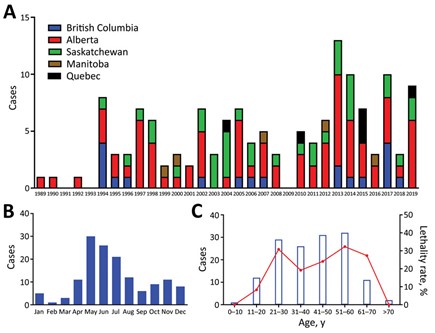
As of May 1st, 2026, the National Microbiology Laboratory has confirmed 168 cases of hantavirus infection in Canada since active surveillance started in 1994. Annually, there is an average of five new cases in Canada. Peak levels of HPS cases are observed with seasonal increases in deer mouse populations in the spring and summer due to increased reproduction. HPS occurs from contact with Sin Nombre hantavirus-infected rodent excreta. Most cases are reported in the southern rural parts of Manitoba, Saskatchewan, Alberta, and British Columbia.
- Government of Canada — Risks of a Hantavirus Infection
- National Microbiology Laboratory — Hantavirus Cardiopulmonary Syndrome in Canada (2020)
- CBC News — What is hantavirus? Everything you need to know
Figure:
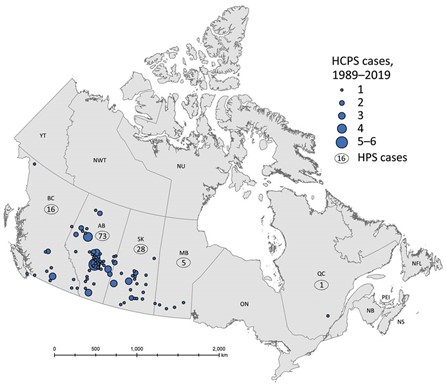
Figure:
Manitoba:
There have been five reported cases of HPS as of 2019.
Ontario:
No cases of HPS have been reported in Ontario.
Alberta:
There have been 16 cases of HPS confirmed in Alberta between 2014 to 2018 whereby one case has been fatal. In total, 77 cases of HPS have been reported as of 2019.
- Alberta Health Services — Hantavirus
- CDC — Figure 2. Cases of HCPS by Province, Year, Month, and Patient Age, Canada, 1989–2019
British Columbia:
According to the BCCDC, three cases of HPS were first reported in British Columbia in 1994. As of 2019, 19 cases have been reported.
- BCCDC — HPS
- CDC — Figure 2. Cases of HCPS by Province, Year, Month, and Patient Age, Canada, 1989–2019
Saskatchewan:
As of 2019, 35 cases of HPS have been reported.
Quebec:
There have been six cases of HPS reported as of 2019. Five of these cases has been from travel to western provinces or military exercises.
Laboratory Diagnosis:
Hantavirus diagnoses are verified through laboratory testing. One or more of the three diagnostic markers must be positive for indication of infection from hantavirus. The only laboratory in Canada that does diagnostic testing for hantavirus infection in humans is the National Microbiology Laboratory in Winnipeg, Manitoba.
The diagnostic markers include:
- hantavirus-specific IgM or rising titers of IgG detection
- hantavirus RNA presence detected by RT-PCR
- positive immunohistochemistry detection for hantavirus antigen
- PHAC — For Health Professionals: Hantavirus Infection
- Government of Canada — Pathogen Safety Data Sheets: Infectious Substances: Hantavirus spp.
- British Columbia Centre for Disease Control (BCCDC) — Hantavirus
Prevention and Control:
Rodent control should be the first measure taken for the prevention of hantavirus infections. This can be done by controlling rodent populations near human communities. Individuals should avoid contact with rodent urine, droppings, saliva, and nesting materials. Safety measures for proper cleaning and disinfection of rodent-infested areas should be followed (as outlined by the PHAC).
Hantavirus spreads through contact with infected rodents’ urine, droppings, or saliva which can be through the air, direct contact or by eating. There is no vaccination currently available for hantavirus infection. The PHAC states that the key to disease prevention is preventing rodent infestations, and properly cleaning and disinfecting areas contaminated by rodent droppings
To keep your home, workplace and/or other sites of living rodent-free, block openings that could be a passageway for rodents, store food and garbage in places with tightly fitted lids, use mousetraps, and maintain yard cleanliness. The virus can survive for 12-15 days in contaminated bedding, 5-11 days in cell culture supernatants at room temperature and for 18-96 days in cell culture supernatants at 4° Celsius.
- PHAC — Prevention of a Hantavirus Infection
- Government of Canada — Pathogen Safety Data Sheets: Infectious Substances: Hantavirus spp.
Effective disinfecting techniques include:
- Wearing a fitted filter mask (which are available at safety supply stores), rubber gloves and goggles
- Ventilating an enclosed area for 30 minutes before cleaning
- Use of any general-purpose disinfectant (i.e., 1 part bleach to 9 parts water) or household detergents
Physical inactivation of the virus can be done by exposure to heat. The virus can be inactivated in a cell culture medium at a temperature of 56° Celsius for 15 minutes or 2 hours for dried viruses.
- Government of Canada — Pathogen Safety Data Sheets: Infectious Substances: Hantavirus spp.
- HealthLinkBC — HPS
Vaccination and Treatment:
Hantavirus infection can be fatal and there is currently no vaccination for this virus. However, there are treatments that can improve patient outcomes. This includes supportive care, medical aid through maintenance of oxygen levels, and measures to prevent dehydration.
The PHAC suggests exploration of the extracorporeal CO2 elimination system to treat HPS. This treatment prevents life-threatening pulmonary edema and cardiogenic shock. For HPS, early detection is crucial for better health outcomes. Infected individuals can receive oxygen therapy in an intensive care unit to help with severe respiratory distress.
- PHAC — Prevention of a Hantavirus Infection
- PHAC — For Health Professionals: Hantavirus Infection
- PHAC — Treatment of Diseases Caused by Hantaviruses
What is happening with the current outbreak of Hantavirus?
On May 2, 2026, a positive laboratory test result for hantavirus was confirmed during an ANDV outbreak on the MV Hondius cruise ship which Canadian travellers were aboard. By May 7, 2026, five confirmed and three suspected ANDV cases resulted in three deaths and three hospitalizations. As of May 11th, 2026, none of the confirmed cases were Canadian and all Canadians who were aboard the cruise were asymptomatic. Three Canadians identified as MV Hondius passengers (2) or a contact of an infected individual (1) have returned to Canada and are currently guided by their home jurisdictions to self-quarantine and monitor for any health changes.
The PHAC conducted a Rapid Risk Assessment to determine the level of risk associated with a traveller infected with ANDV from the MV Hondius cruise ship. The likelihood of ANDV importation into Canada between May 8-22, 2026 is moderate. The overall risk of acquiring ANDV for the general population in Canada, in connection with the ongoing cruise ship outbreak, is low given that person-to-person transmission of ANDV requires prolonged, close contact, making it unlikely that there will be onward spread within Canada even if an infected individual were to arrive in Canada. At this time, ANDV is not considered to be a pathogen with pandemic potential.
There is moderate uncertainty associated with this PHAC Hantavirus Rapid Risk Assessment. The first source of uncertainty stems from a lack of evidence in the specific history of ANDV exposure among travellers re-entering Canada. The other sources of uncertainty result from the assumptions made related to the likelihood of person-to-person transmission of the present ADNV based on an epidemiological analysis of this event, and if the present ADNV differs from recently circulating ANDV in endemic areas.
What is the current risk for Canadians from Hantavirus?
There is a low risk of infection from hantavirus in Canada or in other parts of the world. However, anyone coming into contact with hantavirus-infected rodents is at risk of infection. Infestation of rodents both inside and around homes is the main risk of exposure. Infestations and exposures can occur in places where rodents are present which is inclusive of cottages, trails, and garden sheds.
What measures should be taken for a suspected Hantavirus case or contact?
Public Health Ontario has a General Requisition Test posted on its website. This form asks for the specific virus suspected (HFRS or HPS), symptom onset date, symptoms, and travel history. The website outlines the specimen requirements. Only HPS has been reported in Canada and the U.S.
The BCCDC Public Health Laboratory provides environmental and diagnostic testing whereby a sample container or requisition form can be ordered from their website.
Case and Contact Management:
If an individual has come into contact with rodents, rodent droppings and/or rodent urine, or is experiencing symptoms associated with hantavirus infection, they should contact a health care provider. Details about contact with rodents, rodent droppings, and/or rodent urine should be provided so that rodent-specific diseases, such as HPS and HFRS, can be explored.
Case Definitions:
The Canadian Government is responsible for providing information on hantaviruses and diseases caused by the viruses. The National Microbiology Laboratory in Winnipeg, Manitoba is the only laboratory in Canada that conducts diagnostic testing for hantavirus infections in humans, analyzes trends in hantavirus pulmonary syndrome cases in Canada, and carries out field investigations into hantavirus infection cases across Canada.
- Government of Canada — Surveillance of Hantavirus Related Diseases
- PHAC — Risks of a Hantavirus Infection
Clinical illness is confirmed with laboratory confirmation of infection through one of four methods:
- detection of IgM antibodies to hantavirus or
- detection of a significant (e.g. fourfold or greater) increase in hantavirus-specific IgG antibody titres or
- detection of hantavirus RNA in an appropriate clinical specimen or
- detection of hantavirus antigen by immunohistochemistry
The definition of a clinical illness is indicated by febrile illness (oral temperature greater than 38.3° Celsius) that requires oxygen along with bilateral diffuse infiltrates, and the development of infection within 72 hours of hospitalization.
Identifying and Reporting:
HPS became a nationally reportable disease in 2000. If an individual is experiencing symptoms and has been in contact with rodent droppings, urine or saliva, it is recommended by the PHAC to contact your physician and indicate potential exposure to rodents.
As per Public Health Ontario, test results are reported to the health care provider ordering the test. Positive results are reported to the Medical Officer of Health as required by the Health Protection and Promotion Act.
Date modified: May 21, 2026